On February 26, 2026 the Trump Administration's drastically expanded version of the Global Gag Rule went into effect. The restrictions apply to new issues, new entities, and new funding. Stay tuned to globalgagrule.org for analysis and updates as they are announced. PAI monitors the situation in real-time and will update the website as we learn more. Help power PAI’s fight against the GGR.
Click to toggle navigation menu.

Global Gag Rule

Understanding the Policy

As one of his first actions in office, President Trump re-instated the Global Gag Rule. On February 26, 2026 his administration expanded that already-deadly policy even further to apply to new issues, new entities, and new funding. This policy risks decades of global progress for equality, global health, and human rights by forcing organizations to choose between receiving U.S. assistance and providing accurate, evidence-based services.

For over 40 years, PAI has been documenting the harm of the original global gag rule, which has done irreparable damage to sexual and reproductive health care worldwide.


Understanding the Impact

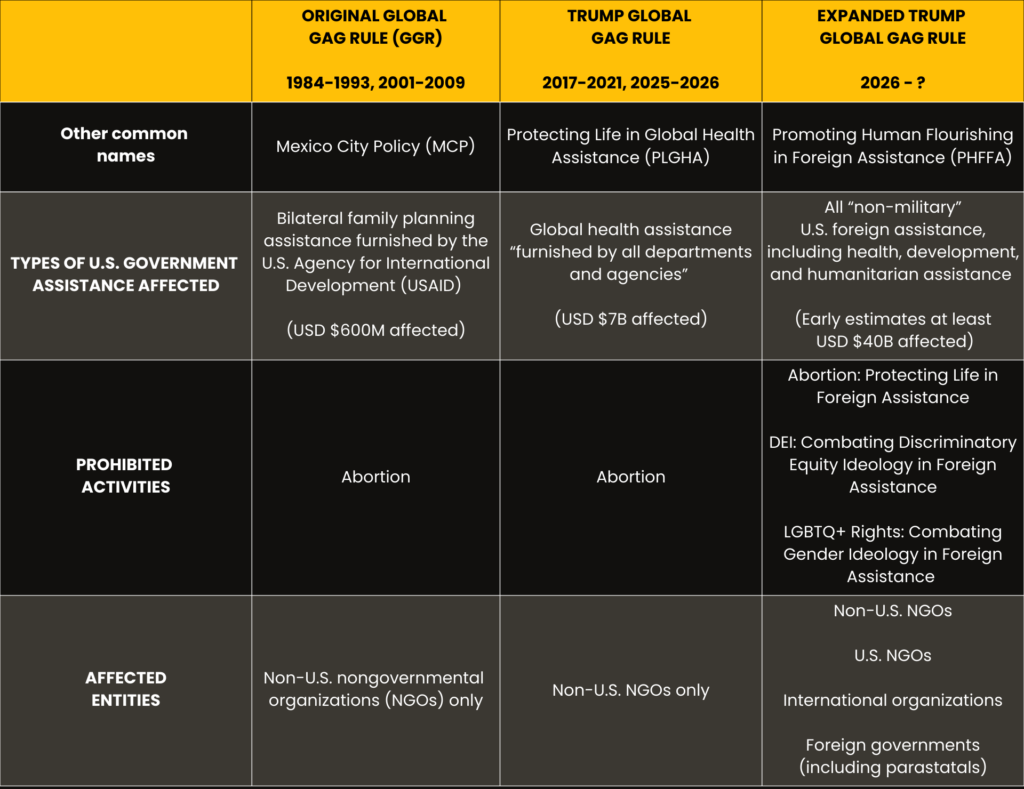
This new policy is a major expansion of the Global Gag Rule’s suppression tactics. In addition to U.S. global health assistance, the new policy will, for the first time: 

  • Apply to U.S.-based NGOs;
  • Apply to the UN and other multilateral organizations;
  • Apply to all non-military foreign aid (This includes all family planning and reproductive health and extends not only to all global health but to all development and humanitarian programs);
  • Bar U.S. foreign assistance from going to any organization, government, or UN agency that “performs or promotes” abortion, and extend that prohibition to groups that advance diversity, equity, and inclusion (DEI), or rights of LGBTQI+ persons. 

Will you be affected by this policy?

The Trump administration’s decision to dramatically expand the Global Gag Rule will be implemented as previous iterations have been, through standard provision language that is attached to new grant or cooperative agreements. The language could be added to bilateral health agreements, impacting other nations for the first time. Entities that choose to comply will be blocked from providing information, referrals, or services for legal abortion or to advocate for access to abortion services in their own countries or for advancing DEI and LGBTQI+ rights. Organizations that refuse to comply with this policy will lose U.S. funding. The already devastating cuts to U.S. foreign assistance will be compounded by this policy, preventing health professionals from delivering essential health services, threatening individuals’ bodily autonomy, and harming women and girls around the world.

This policy will also have enormous impacts on U.S. diplomacy and soft power, with potential threats to other nations’ sovereignty, by leveraging U.S. funding to push other nations to implement anti-rights policies. This could affect a wide range of sectors, including global health, education, governance, agriculture, and nutrition, making those programs less effective.